[Skip to content] [Skip to main navigation] [Skip to user navigation] [Skip to global search] [Accessibility information] [Contact us]

Previous Next
of 16 items

Food & Feasting Across the Generations

  • No Comments

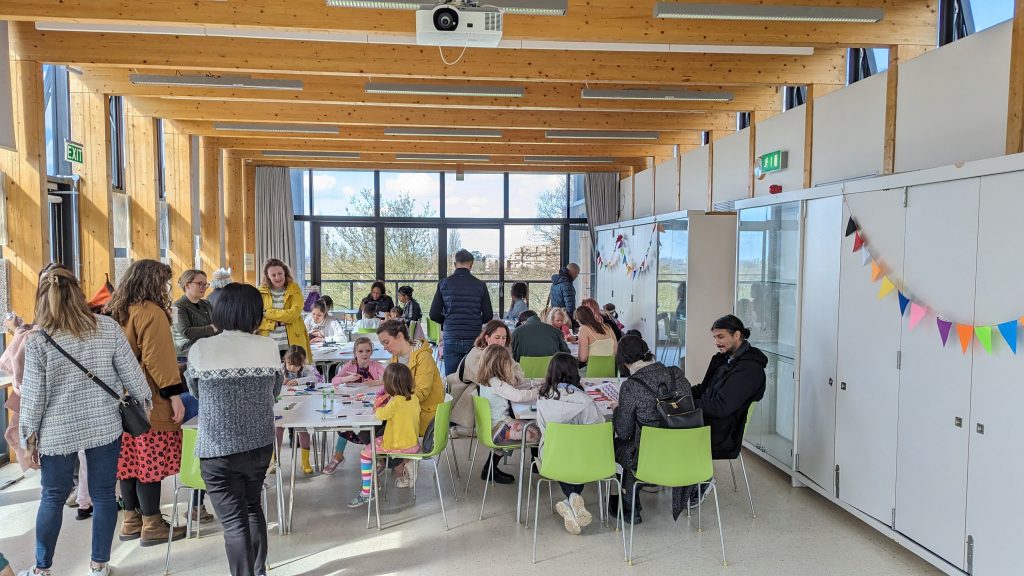
Back in April we held an intergenerational event exploring one of our Collections People Stories themes, Food and Feasting, in partnership with The Children’s Society Greenwich Intergenerational and Community Cohesion Project.

We have been working in partnership with this excellent project for a number of years, and wanted to host an event to raise its profile, while doing some intergenerational work on the theme of food and feasting.

Before the event we had a fun session at the museum to explore the theme. We looked at food-related objects and had some good discussions. We then sat down together to eat a hot lunch and carry on food-based conversations.

The event day was on 3 April and went down really well! Visitors enjoyed being encouraged by participants and artist Caitlin Howell to add to a huge rangoli made from spices, lentil and vegetables. It was great to see Steph, Nasra and Leoni chatting with members of the public.

Watch the time-lapse film Caitlin made of the Rangoli:

Other members of the project cooked food for visitors to try.

Monturayo made pap, fried yam, tamarind and delicious bean fritters. Georgina and Dorreen ran an object handling table (and persuaded people to try some bitter kola nut!). Muriel, Elle and Laura taught families how to make non-cook sweets.

A huge thanks to everyone from the Intergenerational Project for all their hard work.

Lewisham Young Carers Visit

  • No Comments

The Lewisham Young Carers service is based just down the road from the museum in Forest Hill. They support young people who live in a family where someone is affected by a long-term illness or disability.

Over Easter holiday we had the 8-11 year olds and 12-16 year olds groups visit for workshops at the Museum.

As an introduction to the museum, members of the group selected an object from the Handling Collection that they felt represented themselves and then wrote a label for it. This activity is always a lovely way to find out things about each other and for individuals to think about what the things they are important to them.

On the final two days, we looked at some charms from the Lovett Collection.  The Horniman has hundred of Lovett charms from all around the world, and they are a great way of exploring our upcoming Collections People Stories theme, Health and Healing.

Using magnifying glasses we looked closely at the charms and tried to figure out what was on them and helped each other figure out what some things might mean.

This Greek silver amulet case doesn’t have much information about it but as a group we decided the figure must be St George. If you open it up, there is a dried plant – perhaps a herb or a remedy?

Scott selected one to look at that was a small horse-shoe charm with 1917 written on the back, and the word LOOS on the front. Victor got into looking at a blue glass ‘evil-eye’ charm and the small bubbles formed inside the glass when it was made. Chantelle selected a tiny charm with the number 13 on it – which she considers lucky.

We had some brilliant conversations about the charms – can you make your own luck? Do wishes come true? Should you be scared to break a lucky ritual that you have always done? What does religion have to do with luck? How can something become lucky? Which way up should you put a horse-shoe and why?

As a group we also discussed our own lucky charms that we carry around. Click on the images below to see some up close.

Thanks to all the young carers for making this a fantastic and fascinating event!

Tea Drinking Along the Silk Road

  • No Comments

On Tuesday 23 April we were delighted to host a lecture by Helen Saberi, author of numerous books and articles on the history of food and drink.

Following on from research she undertook for her most recent publication Tea: A global history, Helen took us through the story of tea trade along the Silk Road. She illustrated her history with some remarkable examples of tea preparation from across Asia, including a Tibetan recipe whereby black tea is mixed with yak butter and the dregs of the cup mopped up with roasted barley flour.

Another example was qymaq chai, an Afghan wedding tea which mixes green tea with baking soda to turn it pink before milk, sugar and cardamom are added. Finally, the cup is topped off with a ‘float’ of clotted cream.

After the talk we held a tea tasting and, as it was a beautiful evening, we opted to set it outside on the terrace of our new Gardens Pavilion. Since it seemed strange to drink artisanal teas from  impersonal cups we invited guests to bring their own. There was a great selection, with examples ranging from a Czech produced chai cup purchased in Uzbekistan, to a hand-painted mug commemorating sheep and Scotland!

Don’t forget to book for our next Horniman Talk as part of our Food, Drink and Feasting series, when Dr. Any Mills will be exploring Western Polynesian Food and Drink: Acts of Power on Tuesday 21 May.

You can book for this free event, and the other talks in our series, online through EventBrite.

The Horniman welcomes rAndom International

  • No Comments

Last week, the artists behind the Rain Room paid a visit to the Horniman to prepare for their newest work.

Thanks to the support of our fantastic visitors in the Museums at Night vote, rAndom International will be contributing a new installation to our event, The Horniman Garden Party.

In preparation, the group have toured the Horniman to get a real feel for the place and explore the spaces available.

The Horniman Garden Party will be held on 16 May 2013, as part of Museums at Night. To enjoy rAndom International's installation, live music, poetry, alternative museum tours and much more, book your tickets online.

The Horniman Musical Composition Competition

  • No Comments

The Horniman is launching a competition, inviting young musicians to compose a solo harpsichord piece to celebrate a new permanent display of keyboard instruments in the Music Gallery.

The winning piece will earn a young composer £1,000 in prize money, and will premiere at the launch of a display called 'At Home With Music' in January 2014.  It will be performed on the Horniman’s 1772 Jacob Kirckman harpsichord, which is currently being returned to playing condition in a major restoration project. 

The Horniman Musical Composition Competition invites entries from now until 1 October 2013.  Open to those aged 35 and under, the aim is to inspire young composers to get acquainted with an historic English instrument and the exciting sound it has to offer.

The competition will be adjudicated by harpsichordist Jane Chapman, and composers Alexander Goehr and Rhian Samuel.

For more details, including how to enter, please download the competition's full terms and conditions.

Horniman Talks: Food, Drink and Feasting

Over the last few months, the Collections People Stories project has been reviewing the Anthrpology Collections under the them of 'Food Drink and Feasting'. As part of this, we invited a number of historians and anthropologists who have studied this area to respond to our stored collections.

As a result of our work we are hosting a series of talks at the museum between April and July 2013.

Public talks were an important part of the Horniman Museum’s early history. During the first few decades of the 20th century local residents flocked to the Horniman in great numbers to listen to wide diversity of talks giving by prominent anthropologists and naturalists of the day. Topics were eclectic and varied but always connected to the museum’s collections. Early talks included ‘Marine Aquarium’ (1904), ‘Magic and Primitive Societies’ (1905), ‘Why and How we Study Mankind’ (1911) to the ‘Languages of the World’ (1913).

The focus of the 2013 Horniman Talks is on Food, Drink and Feasting. In typical Victorian style, our anthropology collections are stored by type, and we  have a separate storeroom dedicated to food and drink related objects from all around the world. Our documentation teams have been making their way through this room over the past few months, documenting and photographing objects as they go. You can follow their finds on the Tumblr blog.

Given the close history between the Horniman Museum and the tea trade, it may come as no surprise that we have over 600 tea related objects in our collections. In April, Helen Saberi, well known writer on Afghan cuisine and history of tea responds to some of our tea related collections, focusing on Tea Drinking Along the Silk Road. A selection of teas will be available to taste on the night.

In May, Dr Andy Mills will provide a fresh insight into Western Polynesian food culture and the relationship between food and chiefly power and status, drawing off our strong Pacific collections.

In June, we have two talks. First, Dr. Monica Janowski extends her research of the food memories of a group of elderly Polish migrants, who spent time in exile in Africa and Siberia during WWII, now living in London.

In our second June talk, food anthropologist, Dr. Kaori O’ Connor explores the unexpectedly complex and surprising cultural history of gingerbread in Europe.

Our final talk in July will see Professor Harry West, convener of the very popular SOAS Food Studies Centre, present ‘Stories of Cheese-Making Told by its Tools’. A selection of cheese will be available to taste on the night.

These talks run from 7–8pm. Doors open 6.30pm. Booking and entry are free.

To book, email communitylearning@horniman.ac.uk or call 020 8291 8686.

Crossing Borders: Food and Feasting

  • No Comments

Saturday was a busy day at the museum, with our annual event ‘Crossing Borders’. This event is produced in collaboration with Southwark Day Centre for Asylum Seekers and we have been doing it for the last 6 years.

The first activity was an Eritrean Coffee Ceremony led by Abeba and her sister. Abeba started by roasting the green coffee beans - the smell of the roasting beans completely filled the Education Centre.  To add to the smells in the room, she also burnt frankincense.

The roasted beans are then ground and transferred to a pot called a jebena and boiling water poured in.

Abeba had brought her own beautiful little cups to serve the coffee and added a little bit of ground ginger and a good spoonful of sugar to each.

To go with the coffee we ate some of the delicious food made by people from the Centre - Alganesh brought an Eritrean bread called hembesha, Abeba brought popcorn, and Chovan made a pineapple upside-down-cake.

In the afternoon Ahmadzia ran a kite-making workshop. He has been making and flying kites since he was a child.  He had brought with him the exact cotton he needed, specially imported from Afghanistan. Somehow he even demonstrated his skills by flying a kite inside the education centre!

In Gallery Square, we exhibited the work done during our sessions at SDCAS. Each plate and napkin in 'Banquet of Memories' told the story of a different person who attends the Centre.

Along with these went our Pinterest board of suggestions for an International Feast, developed with the help our Twitter and Facebook followers.

It was a really great day and visitors to the museum gave us some good feedback:

‘It was great to see such a lovely community spirit at the coffee ceremony’

‘Today was excellent – great to get people in the local community involved – that’s what made it so good’

‘I enjoyed reading about the values people attach to food and learning the various recipes – thank you!’

What would you bring to an international feast?

  • No Comments

Tomorrow, you can come to the museum to experience Crossing Borders, a day celebrating food and feasting around the world.

This event is developed in collaboration with Southwark Day Centre for Asylum Seekers, which provides a really vital service for the community: as well as advice, advocacy and English classes, they provide a hot lunch for clients. On a cold day like today this is much needed!

The Horniman has worked with SDCAS for many years, so it was great to return and run a workshop with them for this event. We spent time chatting about food customs and favourite meals. Click these pictures to see who likes what.


Share your own stories of foods from around the world: What dish would you bring to an international feast?

Pop onto Twitter or Instagram with the hashtag #foodfeasting to answer. You can also share your answers in Gallery Square tomorrow.


Horniman Christmas Fayre

  • No Comments
Previous Next
of 16 items